
.webp)
If you’re looking for team building activities Singapore teams genuinely enjoy, you’re probably trying to avoid a familiar problem: an activity that looks great on paper but falls flat once your team actually shows up.
From an operator’s perspective, most team building events don’t fail because the idea is bad. They fail because the format doesn’t survive real conditions — mixed personalities, uneven energy levels, tight schedules, and the pressure on organisers to make everything run smoothly.
This guide looks at team building experiences from the ground up. Not just what the activity is, but how people experience it, how organisers manage it, and why certain formats consistently work better than others across corporate team building, schools, and mixed groups.
What the Best Team Building Activities Have in Common
Across thousands of sessions run by team building companies in Singapore, a few patterns repeat themselves.
The best team building activities are structured enough to give clarity, but flexible enough to adapt to group dynamics. They scale cleanly from small teams up to large groups. They allow participation in more than one way, so your team members don’t need to be loud, fast, or athletic to feel involved.
Most importantly, they are professionally facilitated. Facilitation controls pacing, manages energy, and keeps the experience inclusive, which reduces stress for organisers and helps your team stay engaged.
In practice, a well-run 60 to 120 minute team bonding session almost always outperforms a longer, loosely managed programme.
How to Choose a Team Building Activity That Fits Your Team
Choosing a team building experience isn’t about trends. It’s about matching the format to how your team actually behaves.
Group size should always come first. Some team building games feel intimate and effective for 10 people but lose impact once scaled. Formats designed with parallel play, rotations, or independent teams work far better for corporate team building events with larger numbers.
Indoor versus outdoor decisions are usually logistical. Indoor formats offer weather reliability, clearer briefings, and tighter control. Outdoor formats can work well for large groups, but only when space, pacing, and safety are actively managed.
Physical intensity should never be the sole driver of engagement. The most effective team bonding experiences allow contribution through planning, communication, creativity, or execution. This keeps participation high even when energy levels vary.
Budget should be considered in terms of flow, not just price. Lower-cost options often reduce facilitation or structure, shifting responsibility back to the organiser. A slightly higher per-pax investment usually results in a smoother team building event overall.
High-Energy Team Building Activities With Clear Structure
These activities suit teams that enjoy movement and friendly competition, while still benefiting from clear rules and facilitation.
1. Laser Tag
.webp)
Laser tag works best when gameplay is mission-based rather than focused purely on individual scores. Teams coordinate movement, communicate positions, and adapt strategy together.
Because success depends on teamwork instead of speed alone, Laser Tag in Singapore stays inclusive for first-timers and quieter participants.
Group size: 8 pax and above
Pricing: From $25 per pax
2. Archery Tag

Archery tag uses foam-tipped arrows and emphasises positioning and communication. Teams quickly realise that coordination matters more than accuracy, making it one of the more balanced team building games for mixed groups.
Group size: 8 pax and above
Pricing: From $25 per pax
3. Bubble Soccer

Bubble soccer exaggerates movement and turns simple football mechanics into a fun team bonding activity focused on laughter. It works best as a short segment within a larger programme.
Group size: 8 pax and above
Pricing: From $25 per pax
4. Ninja Tag

Obstacle-based ninja tag requires quick planning and team support. Clear rules and timed rounds prevent chaos while keeping energy high.
Group size: 8 pax and above
Pricing: From $25 per pax
5. Saber Tag

Saber Tag shifts the focus to timing and positioning rather than strength. Structured rounds keep gameplay balanced and accessible.
Group size: 8 pax and above
Pricing: From $25 per pax
Strategy and Problem-Solving Team Building Experiences
These formats are ideal for teams that enjoy thinking, discussion, and planning over physical exertion.
6. Amazing Race
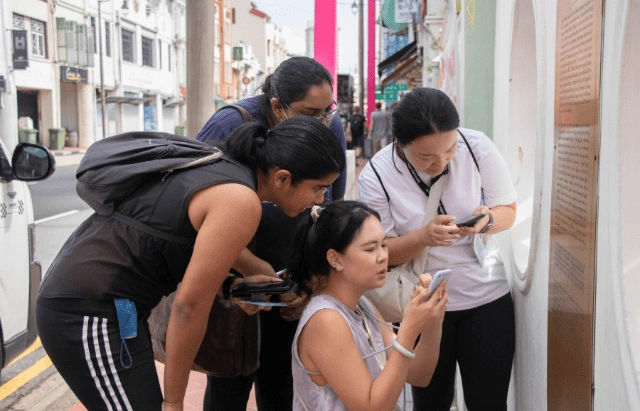
Teams navigate routes, solve clues, and complete challenges independently. This reduces congestion and allows the experience to scale smoothly, making Amazing Race Singapore a popular choice for corporate team building.
Group size: From 2 pax
Pricing: From $28 per pax
7. Escape Room
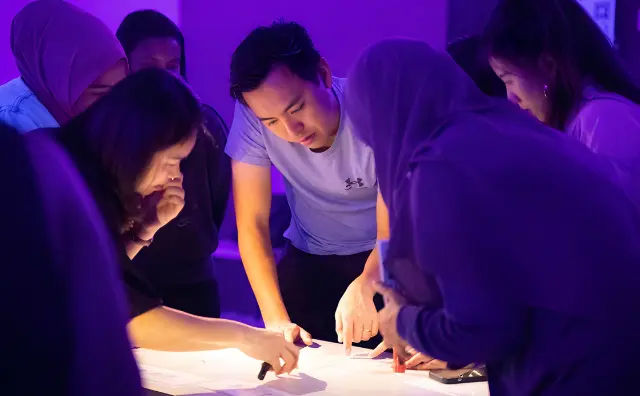
Escape rooms place teams in time-based scenarios where success depends on information sharing and logical reasoning. They work best for focused, indoor team building experiences.
Group size: 8 pax and above
Pricing: From $28 per pax
8. Art Heist
%20-%20Clients.webp)
Art Heist blends puzzle-solving with creative collaboration. Teams work together to solve clues while creating an artwork, encouraging discussion and shared decision-making.
Group size: 5 pax and above
Pricing: From $38 per pax
9. Grand Buffet Mystery

Grand Buffet Mystery is a seated, role-based deduction game that focuses on discussion rather than movement. It works well for large groups or mixed-age teams.
Group size: 5 to 200 pax
Pricing: From $30 per pax
Creative and Low-Intensity Team Bonding Activities
These activities suit teams rebuilding rapport or looking for a calmer team bonding experience.
10. Terrarium Workshop

Participants create miniature ecosystems step by step.
The pace is calm and structured, allowing natural conversation to emerge in the terrarium workshop.
Group size: 5 pax and above
Pricing: From $30 per pax
11. Candle Workshop

Teams design personalised candles, exploring scents and colours together. Each participant leaves the candle workshop with a finished item, giving the session a clear sense of completion.
Group size: 5 pax and above
Pricing: From $32 per pax
12. Leather Workshop
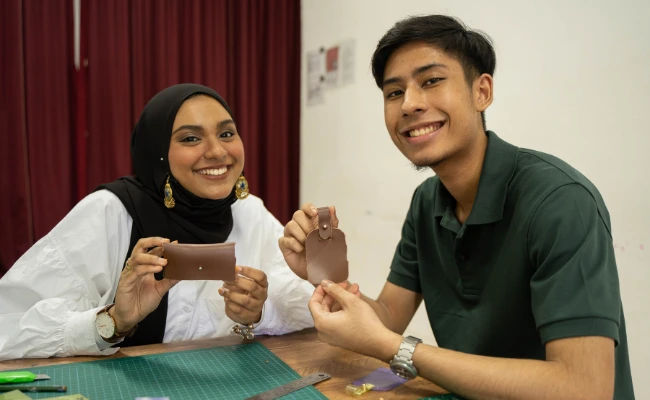
Hands-on crafting encourages focus and patience.
Clear instructions make leather workshop suitable for teams that prefer structured creative work.
Group size: 5 pax and above
Pricing: From $40 per pax
13. Clay Workshop
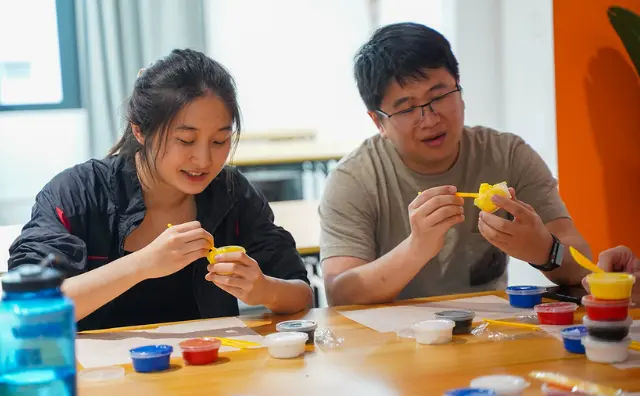
Clay sculpting allows free experimentation with no right or wrong outcome, supporting relaxed interaction in the clay workshop among colleagues.
Group size: 5 pax and above
Pricing: From $25 per pax
14. Balloon Sculpting

Balloon sculpting is a light, informal activity often used as a warm-up or filler, perfect for mixed-energy groups.
Group size: 5 pax and above
Pricing: From $25 per pax
Large-Scale and Rotation-Based Team Building Formats
These formats are designed to handle volume while maintaining engagement.
15. Giant Board Games
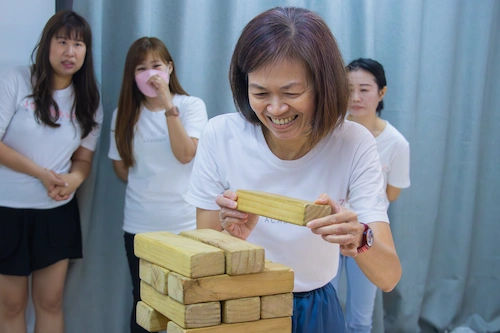
Oversized versions of familiar games encourage casual interaction and teamwork.
Rules are easy to grasp, and physical intensity is low in Giant Board Games.
Group size: 8 pax and above
Pricing: From $20 per pax
16. Funsical 100
%20-%20Clients.webp)
Funsical: 100 is a station-based challenge format combining physical, coordination, and thinking tasks.
Rotations keep energy balanced.
Group size: 20 pax and above
Pricing: From $38 per pax
17. Fun and Furious
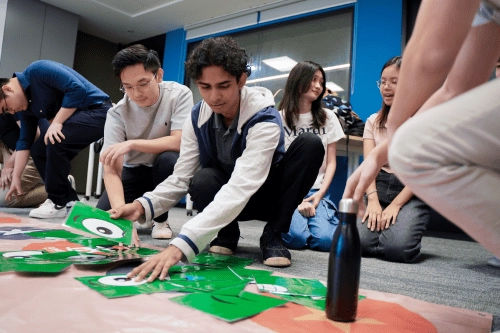
Fun & Furious is a life-sized board game where teams progress through short challenges that test communication and adaptability.
Group size: 20 pax and above
Pricing: From $35 per pax
18. Bullet Strike

Bullet strike involves foam-projectile gameplay with clear objectives and controlled zones. Facilitator oversight ensures safety and smooth flow.
Group size: 8 pax and above
Pricing: From $25 per pax
19. Giant Whack A Mole
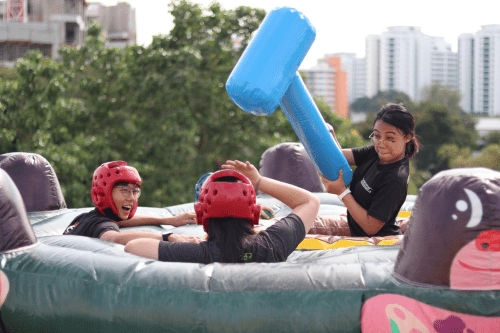
Giant Whack-A-Mole is the oversized version of the classic arcade game, featuring fast-reaction gameplay with quick role rotation, keeping all team members involved.
Group size: 6 pax and above
Pricing: From $30 per pax
20. Poolball

Poolball: Football mechanics meet pool-style strategy. Teams discuss angles and shot order before each turn, making it a collaborative experience.
Group size: 8 pax and above
Pricing: From $25 per pax
Common Team Building Mistakes Organisers Make (And How to Avoid Them)
Most team building sessions don’t fail because the activity is bad. They fail because small planning assumptions go unchecked.
One common mistake is choosing an activity based on how it looks in photos rather than how it runs with real people. High-energy formats can appear exciting, but without clear objectives and facilitation, they often result in uneven participation where a few people dominate while others disengage.
Another frequent issue is underestimating transition time. Briefings, movement between stations, and team regrouping all take longer than expected, especially with large groups. When transitions are rushed or unclear, energy drops quickly and organisers feel pressured to “catch up,” which rarely improves engagement.
Organisers also tend to over-programme. Trying to squeeze too many activities into a single session leaves teams mentally fatigued and reduces the impact of each experience. In practice, fewer well-run segments outperform packed schedules almost every time.
The most reliable way to avoid these issues is to prioritise formats with built-in structure and experienced facilitation. Clear pacing, defined roles, and realistic time buffers protect the experience from small disruptions that would otherwise compound into visible friction.
How Team Size Changes the Way Activities Feel
Team building activities behave very differently at different scales, even when the activity itself stays the same.
For small groups, intimacy matters more than spectacle. Activities that allow everyone to speak, plan, and react together — such as escape rooms, small-scale laser tag missions, or creative workshops — feel personal and cohesive. Too much structure can feel restrictive at this size.
As group size increases, clarity becomes more important than flexibility. Once you exceed around 40 participants, unstructured formats begin to fragment. Instructions need to be repeatable, teams must operate independently, and facilitators need visibility over multiple groups at once.
Large-scale sessions require activities that are designed to absorb variation. Station-based challenges, Amazing Race formats, and rotation games work because no single bottleneck can derail the entire programme. Teams that finish early remain engaged, and slower teams don’t feel pressured.
Understanding how scale alters group behaviour helps organisers avoid forcing a small-group activity into a large-group context where it no longer performs as intended.
Why Clear Objectives Matter More Than Competition
Many organisers default to competition as a way to drive engagement, but competition without purpose often backfires.
When winning becomes the sole focus, quieter participants may disengage, risk-taking increases unnecessarily, and teams can become inward-looking rather than collaborative. This is especially noticeable in corporate groups with mixed seniority or uneven confidence levels.
Activities that frame competition around objectives rather than scores tend to produce better outcomes. For example, completing a mission, unlocking progress, or achieving collective milestones gives teams something to rally around without excessive pressure.
From an operator’s perspective, the most successful sessions are those where participants can clearly answer three questions at any point:
What are we trying to achieve?
How do we know if we’re doing well?
What role can I play right now?
When these are clear, engagement stays high regardless of whether the activity is competitive, creative, or strategic.
Managing Mixed Energy Levels in a Single Session
One of the most underestimated challenges in team building is managing mixed energy levels within the same group.
In almost every session, there will be participants who are eager to jump in immediately and others who prefer to observe before engaging. Activities that assume uniform enthusiasm tend to alienate the latter group.
Effective formats build in multiple entry points. Early tasks might reward planning or observation before requiring physical execution. Rotating roles allow participants to contribute without being constantly “on.” Short rounds prevent fatigue from accumulating.
Facilitators play a key role here by normalising different participation styles. When quieter contributions are acknowledged and valued, teams naturally balance themselves without forced intervention.
This approach is particularly important in corporate team building, where psychological safety influences participation as much as physical ability.
How Facilitation Shapes Group Behaviour in Real Time
Facilitation is not just about explaining rules. It is about reading the room and adjusting the experience while it is happening.
Experienced facilitators recognise early signs of disengagement, confusion, or dominance. They know when to pause a session, reframe objectives, or subtly redistribute roles without drawing attention to the issue.
For example, if one participant begins directing all decisions, a facilitator might introduce time-limited roles or require consensus before actions are taken. If energy dips, they may shorten a round or clarify progress markers to restore momentum.
Without facilitation, these adjustments rarely happen. Groups either push through awkward moments or disengage quietly, both of which reduce the overall value of the session.
This is why facilitation quality often has a greater impact on outcomes than the activity format itself.
Planning Team Building Around Time Constraints
Time constraints influence behaviour more than most organisers expect.
Shorter sessions force clarity. When teams know there is limited time, they focus faster, communicate more directly, and commit to decisions instead of over-discussing options. This is why well-run 60–90 minute sessions often feel more satisfying than longer programmes.
Longer sessions require variation to sustain engagement. Mixing physical movement with thinking tasks or creative segments helps reset attention. Without variation, even motivated teams begin to disengage.
It is also important to plan for energy peaks and troughs. Opening with an activity that is too intense can exhaust participants early, while ending with a low-engagement segment can make the session feel anticlimactic.
A deliberate arc — warm-up, engagement peak, and controlled wind-down — improves how the entire programme is remembered.
Psychological Safety and Participation
Participation is rarely about ability alone. Psychological safety plays a significant role in whether people engage fully.
Activities that publicly spotlight mistakes or reward only the loudest voices discourage risk-taking. Over time, participants learn to stay quiet rather than contribute imperfect ideas.
Formats that encourage experimentation, shared responsibility, and collective success create safer environments. When teams are allowed to try, fail, and adjust without penalty, communication improves naturally.
This is particularly important for new teams, cross-department groups, or sessions involving mixed seniority. Structured rules and clear facilitation reduce ambiguity, which in turn lowers social risk.
Using Team Building to Support Broader Workplace Goals
Team building works best when it supports, rather than replaces, existing workplace objectives.
For example, teams struggling with communication benefit from activities that require information sharing under light pressure. Teams experiencing siloed thinking respond well to formats that require cross-role collaboration.
Creative workshops can be effective after periods of high stress, as they allow teams to reconnect without performance metrics. High-energy games are often more effective when morale is already stable and the goal is momentum rather than repair.
Aligning activity choice with the team’s current state prevents mismatched expectations and increases perceived relevance.
What Organisers Should Clarify Before Booking
Before committing to a team building activity, organisers benefit from clarifying a few key points:
Who will be in the room, and what are their comfort levels?
What does success look like for this session?
How much structure does the group need?
What constraints exist around time, space, or budget?
Who will manage flow and decision-making on the day?
Answering these questions upfront reduces last-minute changes and ensures the selected format supports, rather than complicates, the organiser’s role.
Why “Fun” Alone Is Not a Reliable Metric
Fun is subjective, situational, and temporary. What feels fun to one participant may feel stressful or uncomfortable to another.
From an operational standpoint, reliable team building outcomes come from clarity, inclusion, and execution. When participants understand what they are doing, feel safe contributing, and experience smooth flow, fun tends to emerge naturally.
Activities that rely solely on novelty or excitement often struggle to sustain engagement once the initial curiosity fades.
This is why structured team building activities continue to outperform purely free-play formats in professional settings.
Final Thoughts
Choosing the right team building activities in Singapore comes down to structure, inclusivity, and execution quality.
When a team building company designs experiences around real group behaviour and supports them with strong facilitation, organiser stress drops and participation rises.
If you’re looking for a team bonding experience that actually works for your team — whether you’re planning for 10 people or up to a few hundred — clarifying your objectives and constraints early makes all the difference.
A short conversation with an experienced team building company often helps you identify what will work best, before any commitment is made.
FAQs About Team Building Activities in Singapore
What team building activities work best for mixed teams in Singapore?
Activities that allow different forms of contribution tend to perform best. Formats like laser tag missions, Amazing Race–style challenges, creative workshops, and giant games let participants engage through communication, planning, creativity, or coordination rather than physical ability alone. This keeps participation balanced even when energy levels and personalities vary.
How do I decide which team building activity suits my group?
Start with practical constraints such as group size, venue type, and preferred intensity level. From there, clarify whether your goal is energy, communication, or cohesion. Structured activities with professional facilitation generally adapt better to real-world group dynamics and reduce friction on the day itself.
Are team building activities in Singapore suitable for large groups?
Yes, but only certain formats scale cleanly. Station-based games, Amazing Race challenges, and rotation-style activities are commonly used for larger groups because they prevent congestion and keep everyone involved. Free-play formats usually struggle once group size increases.
How much should I budget for team building activities in Singapore?
Most team building activities in Singapore fall between $20 and $50 per pax, depending on group size, duration, and facilitation. When comparing options, it’s important to consider what’s included, such as facilitators, equipment setup, and pacing management, rather than focusing on price alone.
How long should a team building session ideally run?
From an engagement perspective, most teams perform best in sessions lasting between 60 and 120 minutes. This timeframe allows enough depth for meaningful interaction without causing fatigue or disengagement, especially for mixed-energy groups.
Do team building activities require professional facilitators?
While not strictly mandatory, facilitation has a significant impact on outcomes. Facilitators manage time, clarify objectives, balance participation, and adapt to group dynamics in real time. For corporate or large-group settings, facilitation often makes the difference between a smooth experience and a fragmented one.
Are team building activities appropriate for participants who prefer low-intensity interaction?
Yes. Many teams actively choose low-intensity formats such as creative workshops, puzzle-based games, or strategy-led activities. These options support connection and communication without relying on physical exertion or competitive pressure.