
.webp)
If you’re searching for the best laser tag in Singapore, you’re almost certainly not just looking for a fun activity.
You’re planning something that needs to work:
- A corporate or departmental team building event
- A school or youth programme
- A birthday party involving mixed ages
- A laser tag event where timing, safety, and engagement must be controlled
At this stage, the real question isn’t what is laser tag or whether laser tag is a fun concept.
The real question is simple but high-stakes:
Will this laser tag experience actually run smoothly when real people show up?
From on-ground operator experience, laser tag rarely fails because the game itself is boring.
It fails because organisers underestimate execution complexity.
This guide is written for organisers — the people responsible when:
- Instructions aren’t clear
- Participants disengage
- Sessions run late
- Equipment issues surface
- Energy drops halfway through
What “Best Laser Tag Singapore” Really Means Once You’re Responsible
For participants, playing laser tag feels instinctive and exciting.
For organisers, it’s a controlled system with many moving parts.
In real-world events, the best laser tag experience usually means:
- Participants understand the laser tag game within minutes
- Everyone can play laser tag at the same time without congestion
- The laser tag gun feels intuitive even for first-timers
- Laser tag games maintain momentum across rounds
- The session starts and ends on schedule
Casual free-play formats can work for friends.
But once group size increases, confidence levels vary, or timing matters, structure becomes the difference between smooth and chaotic.
That’s why most organisers begin with broad searches like tag Singapore laser or laser tag provider in Singapore, then narrow down based on execution capability rather than visuals.
How Laser Tag Providers Actually Differ on the Ground
Most providers look similar online.
In reality, differences show up within the first 10 minutes of gameplay.
Gameplay Structure
Strong providers rely on defined laser tag game modes instead of open roaming. This:
- Prevents crowding
- Balances participation
- Controls round length
- Reduces confusion for first-timers
Without structure, dominant players take over while quieter participants fade out.
Facilitation Quality
Facilitators are not referees. They are flow managers.
They:
- Clarify rules clearly and calmly
- Control pacing between rounds
- Reset teams efficiently
- Intervene before energy drops
This matters far more than premium laser tag equipment.
Scalability
Running laser tag for 8 pax is easy.
Running it for 40, 80, or more requires:
- Rotation planning
- Spare equipment
- Clear command structure
- Time buffers
This is where many sessions quietly fall apart.
Laser Tag Providers in Singapore (Organiser-Focused Breakdown)
Below is a practical breakdown of providers, ordered for decision clarity and based strictly on the original reference.
1. Laser Tag SG
.webp)
Best for: casual group play and straightforward sessions
Laser Tag SG is commonly chosen by:
- Friends
- Small private groups
- Informal laser tag games
The experience is simple and accessible, allowing anyone to start playing quickly with minimal briefing.
This works well for social groups, but organisers planning structured team building events may need additional coordination to manage pacing, rotations, and engagement.
2. FunEmpire
.webp)
Best for: multi-activity corporate and social events
FunEmpire offers laser tag as part of a wider portfolio of group activities.
Laser tag here is typically used in:
- Corporate team building events
- Company outings with multiple activities
- Social and recreational programmes
The key advantage is flexibility. Laser tag usually acts as one component within a broader event rather than the sole focus.
This works best when variety matters more than depth.
3. Laser Tag Singapore
.webp)
Best for: structured laser tag events and larger groups
Laser Tag Singapore focuses on professionally facilitated laser tag experiences.
Common use cases include:
- Corporate team building events
- Schools and youth programmes
- Birthday parties with mixed ages
- Large-scale or mass participation laser tag events
Sessions typically include:
- Clear safety briefings
- Balanced team allocation
- Defined laser tag game modes such as Last Man Standing
- Active facilitation to maintain flow
They offer indoor and outdoor laser tag, as well as mobile setups that can be run almost anywhere.
Typical group size & pricing:
Usually suitable for 8–80 pax, starting from around $25 per person, with custom arrangements for larger groups.
4. Laser Quest Singapore
.webp)
Best for: classic arena gameplay and small groups
Laser Quest Singapore operates a traditional indoor arena.
Suitable for:
- Small groups
- Casual sessions
- Families and friends
The fixed arena format provides familiarity, but capacity and rotation limits make it less flexible for large corporate or school groups.
5. Team Building Singapore
.webp)
Best for: corporate programmes with defined objectives
Laser tag is positioned as part of broader team building events at Team Building Singapore, supporting goals such as communication and collaboration rather than acting as the main attraction.
6. Team Building Games Singapore
.webp)
Best for: teamwork-focused corporate bonding
Laser tag is framed as a team building game at Team Building Games Singapore, emphasising cooperation and strategy over pure competition.
7. Team Building Squad
.webp)
Best for: retreat-style or cohesion-focused events
At Team Building Squad, laser tag is used to energise participants within larger programmes rather than as a standalone experience.
8. Team Building Activities Singapore
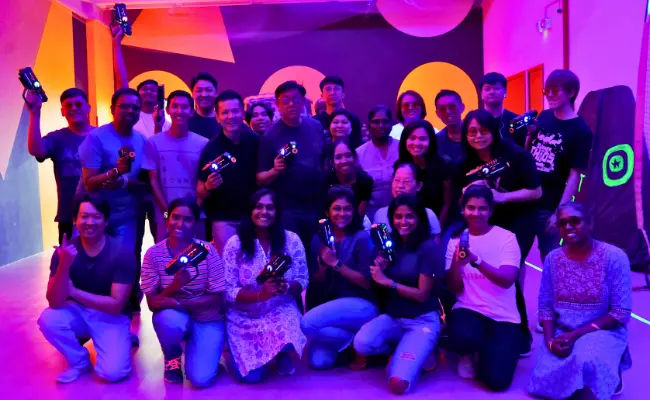
Best for: organisations comparing multiple formats
Laser tag depth depends heavily on overall programme design and facilitation at Team Building Activities Singapore.
9. Birthday Party Singapore
.webp)
Best for: casual celebrations and family-friendly sessions
At Birthday Party Singapore, Laser tag birthday party sessions prioritise fun, inclusion, and ease of play over competitive depth.
Corporate Team Building: Why Companies Keep Choosing Laser Ta
Laser tag continues to be one of the most requested team building game formats in Singapore — not because it’s trendy, but because it consistently delivers engagement.
From a corporate perspective, laser tag works because:
- Participation is voluntary but natural
- Interaction feels organic, not forced
- Hierarchy temporarily disappears
- Leadership skills emerge informally
Unlike workshops or discussion-based activities, laser tag does not require people to “open up”.
Behaviour reveals itself naturally through gameplay.
Managers often observe:
- Who takes initiative
- Who communicates clearly
- Who supports teammates
- Who adapts under pressure
These insights emerge without any formal evaluation.
School & Youth Programmes: Why Execution Is Different
Laser tag works extremely well for schools and youth groups — when execution is adapted.
Key differences from corporate groups include:
- Shorter attention spans
- Higher movement energy
- Greater need for supervision
- Clearer safety enforcement
Providers experienced with youth groups:
- Run shorter rounds
- Repeat instructions calmly
- Use simpler game modes
- Maintain higher facilitator-to-player ratios
Without these adjustments, sessions quickly become chaotic.
Venue & Space Constraints: What Actually Works (and What Breaks Sessions)
One of the biggest misconceptions is that laser tag can run “anywhere”.
In reality, organisers should consider:
- Minimum safe movement space
- Ceiling height
- Columns and blind corners
- Entry and exit flow
- Briefing and holding areas
Indoor spaces with low ceilings or heavy echo can affect communication.
Outdoor venues need lighting consideration and weather buffers.
Good providers will assess space honestly rather than forcing a setup.
Laser Tag vs Other Team Building Games
Laser tag is often compared against other formats. Understanding when it wins — and when it doesn’t — matters.
Laser Tag vs Workshops
Laser tag wins when engagement is the priority.
Workshops win when reflection and theory matter more.
Laser Tag vs Amazing Race
Laser tag is better for contained spaces and shorter time blocks.
Amazing Races work better for exploration and longer durations.
Laser Tag vs Sports-Based Activities
Laser tag is more inclusive. Physical fitness matters far less.
Laser Tag Game Modes: Why Structure Determines Success
Not all laser tag games work for all groups.
Last Man Standing
High energy but risk of early elimination. Best used in short rounds.
Objective-Based Modes
Encourage teamwork and communication. Ideal for corporate groups.
Tag Team Formats
Balance skill levels and reduce downtime.
The best laser tag game keeps players active, not spectating.
Equipment & Safety: What Actually Matters
While laser tag equipment must be reliable, what matters more is:
- Clear explanation of how the laser tag gun works
- Intuitive scoring
- Smooth reset process
Laser tag is non-contact and safe for anyone when rules are enforced consistently.
Pre-Event Planning Timeline (What Organisers Should Do)
1–2 Weeks Before
- Confirm group size
- Finalise venue layout
- Lock in game modes
- Clarify manpower
2–3 Days Before
- Reconfirm timing
- Review space constraints
- Check contingency plans
On the Day
- Allow buffer for briefing
- Identify holding areas
- Confirm escalation points
Common Risk Scenarios That Derail Laser Tag Events
- Rushed briefing → confusion throughout
- One faulty laser tag gun → perceived unfairness
- No rotation plan → long waiting times
- Weak facilitation → organiser forced to intervene
None of these appear on brochures, but all affect experience.
When Laser Tag Is the Wrong Choice
Laser tag may not be suitable if:
- The group resists physical movement entirely
- Noise must be minimal
- Space constraints are severe
- Deep reflection is the main objective
Honest providers will flag this early.
Pricing Expectations for Laser Tag in Singapore
Most sessions fall around:
- From ~$25 per pax for standard setups
- Custom pricing for large or mobile events
Pricing depends on:
- Indoor and outdoor laser tag format
- Group size
- Number of facilitators
- Game play duration
Always confirm what’s included before you request a quotation.
Laser Tag for Mixed Groups: Handling Age Gaps, Fitness Gaps, and Confidence Levels
One reason laser tag remains popular is its ability to accommodate mixed groups — but only when the session is designed correctly.
In real events, organisers often underestimate how different participants experience the same laser tag game. Age, fitness level, and confidence play a bigger role than most expect.
For mixed-age groups, younger participants tend to adapt quickly to movement and equipment, while adults often hesitate during the first round. Without reassurance and clear instructions, adults may hold back unnecessarily. Good facilitators address this by normalising mistakes early and keeping initial rounds short.
Fitness gaps matter less in laser tag than in sports-based activities, but they still influence behaviour. Participants who are less mobile may avoid aggressive movement or feel disadvantaged. Structured laser tag game modes that reward teamwork and positioning — rather than speed alone — help keep participation balanced.
Confidence gaps are the most common issue. In unstructured sessions, confident players dominate while quieter participants disengage. This is where facilitation and rule design matter. Clear objectives, team-based scoring, and rotation systems ensure that everyone remains involved.
For organisers managing diverse groups, laser tag works best when:
- Early rounds are simple and forgiving
- Game modes emphasise objectives, not elimination
- Facilitators actively redistribute roles and teams
When these elements are present, laser tag becomes inclusive rather than intimidating.
How Laser Tag Supports Leadership and Team Dynamics (Without Forced Activities)
One reason companies continue to book laser tag for team building events is that leadership behaviours emerge naturally.
Unlike workshops or discussion-based activities, laser tag does not ask participants to “perform” teamwork. Instead, behaviour surfaces organically through game play.
During sessions, organisers often observe:
- Who steps up to coordinate team movement
- Who communicates calmly under pressure
- Who adapts strategy when plans fail
- Who supports teammates rather than chasing individual scores
These behaviours appear without instruction. Participants are focused on the game, not on being evaluated.
This makes laser tag particularly effective for teams that resist traditional team building formats. There is no public speaking, no role play, and no forced sharing. Interaction feels voluntary, which lowers resistance and increases authenticity.
From an organiser’s perspective, laser tag offers insight without formal assessment. Managers often leave sessions with clearer impressions of team dynamics — not because they were analysing, but because patterns became obvious through play.
This is why laser tag continues to outperform many “learning-heavy” activities when the goal is engagement and cohesion rather than formal training.
Noise, Crowd Flow, and Energy Management: Operational Factors That Affect Experience
Many organisers focus on the laser tag game itself and overlook environmental factors that quietly affect experience.
Noise is a major one. Indoor spaces with strong echo can make briefings hard to hear, especially for larger groups. If participants miss instructions early, confusion persists throughout the session. Good providers compensate by:
- Using clear hand signals
- Repeating key rules calmly
- Positioning groups strategically during briefings
Crowd flow is another overlooked issue. Without proper entry and exit planning, players collide, bottlenecks form, and energy dissipates. This is especially common in mobile setups or non-traditional venues.
Energy management also matters more than most organisers expect. Long gaps between rounds kill momentum. Short, structured rounds with quick resets maintain engagement far better than extended free play.
Experienced laser tag providers plan:
- Staggered rotations
- Clear holding areas
- Fast equipment resets
These details don’t appear on marketing pages, but they determine whether the experience feels smooth or frustrating.
Questions Organisers Should Ask Before Confirming a Laser Tag Booking
Before finalising a laser tag event, organisers can reduce risk significantly by asking a few specific questions.
Instead of focusing only on price or duration, ask:
- How many facilitators will be on-site for my group size?
- What laser tag game modes are included, and how are they chosen?
- How do you manage rotations so players aren’t waiting too long?
- What happens if equipment fails during the session?
- Can everyone play laser tag at the same time, or will groups be split?
Clear, confident answers usually indicate experience. Vague responses often signal that execution details have not been fully thought through.
For larger or time-sensitive events, these questions matter more than branding or visuals. A well-run laser tag experience depends on preparation, not assumptions.
Final Takeaway
Laser tag succeeds when:
- Game play is structured
- Facilitation is active
- Equipment is reliable
- The experience is designed around real people
If you’re planning a laser tag experience, execution matters more than hype.
If you’re unsure what format fits your group, get in touch with a provider that understands laser tag on the ground — not just in theory.
That’s how laser tag becomes a successful event — not just a fun idea.
Laser Tag in Singapore: Quick FAQs
Is laser tag safe for beginners and kids?
Yes. It’s non-contact, supervised, and includes safety briefings.
How many people can play at once?
With proper rotation and facilitation, both small and large groups can be accommodated.
Do players need to be fit?
No. Strategy and communication matter more than speed.
How long does a session usually last?
Most run about an hour, including briefing and multiple game rounds, with flexibility for larger events.